
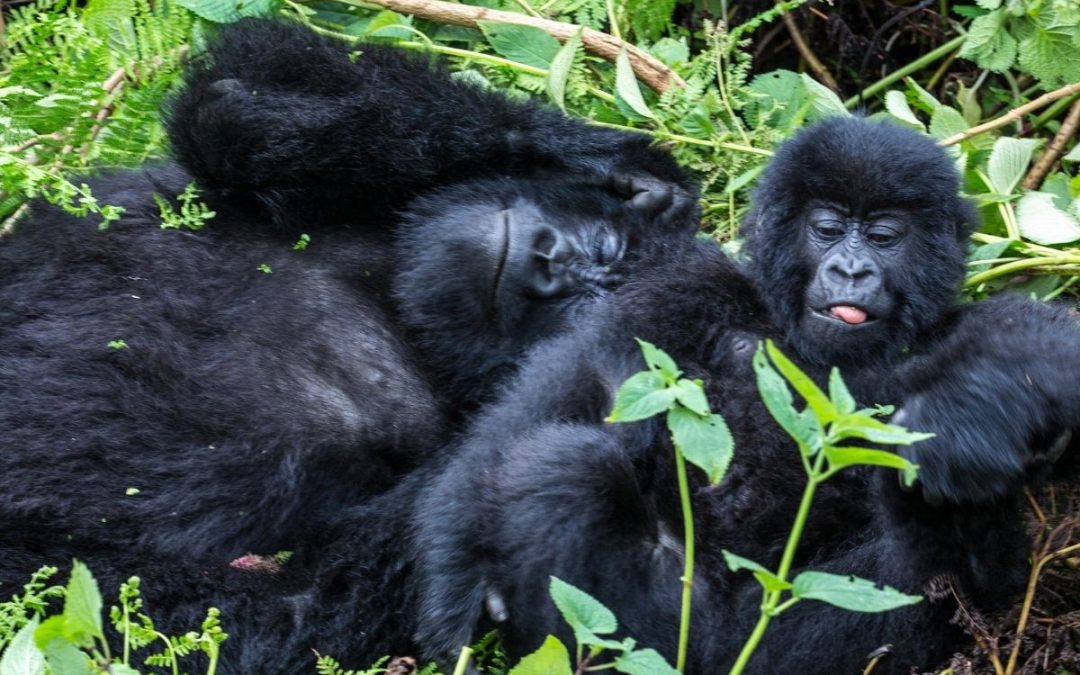
Choosing where to track mountain gorillas comes down to Rwanda and Uganda. They are the two most popular places in the world for the experience, they are often priced very differently, and the trip on the ground is not identical in either country.
This guide sets the two side by side, in terms of cost, access, the trek itself, and what each country offers beyond the gorillas, so you can decide which best suits your itinerary and budget.
Rwanda vs Uganda gorilla trekking at a glance
Where you trek
Rwanda’s gorillas live in Volcanoes National Park, in the Virunga Mountains. Uganda’s are in Bwindi Impenetrable National Park and, in smaller numbers, Mgahinga Gorilla National Park.
Standard permit (2026, foreign non-resident). Rwanda charges USD 1,500 per person; Uganda charges USD 800. This is the clearest difference between the two.
Time with the gorillas. Both give you one hour once you reach the family. Uganda additionally offers a habituation experience of up to four hours.
Getting there. Rwanda’s park is a 2–3 hour drive from Kigali airport. Uganda’s Bwindi is an 8–11 hour drive from Entebbe, or roughly a 1.5 hour flight plus a short transfer.
Habituated families. Rwanda has around a dozen; Uganda has roughly twenty or more, spread across four sectors.
Minimum age. 15 in both countries.
Best paired with. Rwanda suits compact, high-end trips alongside Nyungwe’s chimps and Akagera’s Big Five. Uganda pairs naturally with chimpanzees in Kibale and savannah game in Queen Elizabeth National Park on a longer circuit.
The gorillas themselves are the same
Rwanda’s Volcanoes National Park and Uganda’s Bwindi and Mgahinga parks protect the same endangered mountain gorilla, living within the same chain of forested highlands along the Rwanda–Uganda–DR Congo borders.
In each case you hike to a habituated family, spend one hour in their presence once they are located, and observe from a respectful distance under the guidance of trained rangers. The wildlife encounter itself is broadly equivalent. The meaningful differences lie in cost, the journey to reach the park, and what surrounds the trek.
Permit cost
For most travellers, the permit price is the deciding factor. A standard gorilla permit in Rwanda costs USD 1,500 per person for foreign non-residents, while the equivalent permit in Uganda costs USD 800, a difference of USD 700 per person, per trek. As many visitors trek more than once during a trip, the gap can amount to well over a thousand dollars for a couple before flights or accommodation are taken into account.
Both permits cover the same essentials: park entry on the day of the trek, the services of the guides, trackers and armed rangers who accompany the group, and one hour with the gorilla family once it is reached. Neither price includes transport to the park, accommodation, meals, gratuities, or the optional porter available at the trailhead (approximately USD 15–20, and strongly recommended on a steep, demanding climb).
Residents and African travellers pay considerably less in both countries. Rwanda charges USD 500 for foreign residents and African nationals, and USD 200 for Rwandan and East African Community citizens. Uganda charges USD 700 for foreign residents, USD 500 for other African nationals, and a substantially reduced shilling rate for East African Community citizens. For anyone holding East African citizenship or residency, this is a significant consideration and worth confirming at the time of booking.
Uganda’s four-hour habituation experience
Uganda offers an option that Rwanda does not: a gorilla habituation experience in Bwindi’s Rushaga sector, in which a small group accompanies researchers tracking a family that is still becoming accustomed to people, spending up to four hours with them rather than one. It is more demanding, more intimate, and restricted to a limited number of permits each day.
The habituation permit currently costs USD 1,500. Note, however, that the Uganda Wildlife Authority will raise it to USD 1,800 for foreign non-residents from 1 July 2026, so the applicable figure depends on your travel date.
Low-season discounts and booking requirements
Both countries offer incentives for off-peak travel. Rwanda provides a 30% discount on the gorilla permit (reducing it to USD 1,050) during the November–May low season, on the condition that you also spend at least two nights in its other parks, Akagera and Nyungwe.
Uganda reduces its standard permit to USD 600 in the quietest months. One practical point regarding Uganda, as of 2026, permits must be paid in full at the time of booking rather than held on a short reservation.
In both countries, permits are strictly limited and routinely sell out months in advance for peak dates, so it is standard practice to secure the permit before arranging the rest of the trip.
Getting there
Accessibility is where Rwanda justifies its premium. Volcanoes National Park lies roughly two to three hours by road from Kigali International Airport on good tarmac, making a short, efficient trip entirely feasible: arrive, stay one night, trek the following morning and depart. A genuine long-weekend gorilla trip is realistic.
Uganda’s gorillas are located in the far south-west, and the drive from Entebbe to Bwindi is considerable, commonly eight to eleven hours, depending on which of the park’s four sectors you are visiting.
Many travellers avoid most of this by taking a domestic flight of around ninety minutes to one of the airstrips near the park (Kihihi for the northern sectors, Kisoro for the south), followed by a short ground transfer.
The flight adds cost but reduces a full day of travel to a morning. If the priority is the shortest, simplest route to the gorillas, Rwanda holds the advantage; for travellers comfortable with a longer journey or a domestic flight, Uganda remains very manageable.
The trek itself
Neither country offers an easy walk, and difficulty depends far more on where the gorillas happen to be on a given day than on the destination.
In Rwanda, the route climbs the volcanic, frequently muddy slopes of the Virungas through bamboo and montane forest, often at altitude, which can be taxing.
In Uganda, Bwindi is dense rainforest, as the name “Impenetrable” suggests, with steep, slippery, root-laden terrain that many trekkers find more physically challenging than anticipated.
A trek may take anywhere from one to seven hours each way. A reasonable level of fitness, sturdy waterproof boots, and a tolerance for mud serve well in both, and engaging a porter considerably improves the experience.
Number of gorilla families and permit availability
Uganda has more gorillas open to visitors. Bwindi’s habituated families are distributed across four sectors, Buhoma, Ruhija, Rushaga and Nkuringo, with a further family in neighbouring Mgahinga, totalling roughly twenty or more groups.
Rwanda’s Volcanoes National Park has around a dozen. Both countries limit visits to eight people per family per day in order to protect the animals, so Uganda’s greater number of families translates into more daily permits and, frequently, slightly easier availability for popular dates, along with a wider choice of trekking sector and lodge.
What else each country offers
Once cost is set aside, this is often the deciding factor, since few travellers journey to East Africa solely for one hour with the gorillas.
Uganda rewards a longer itinerary. Options include tracking chimpanzees in Kibale Forest, a classic savannah game drive in Queen Elizabeth National Park (well known for its tree-climbing lions), golden monkey trekking in Mgahinga, and a boat cruise on the Kazinga Channel. It suits travellers seeking a varied, multi-stop safari who are content to cover ground in the process.
Rwanda is compact and refined. Beyond the gorillas, you can track chimpanzees and cross a canopy walkway in Nyungwe Forest, search for the Big Five in the restored Akagera National Park, and explore Kigali, one of Africa’s cleanest and most walkable capitals. Distances are short and the lodges lean towards high-end comfort, making it well suited to travellers who want a polished, lower-effort itinerary in less time.
Best time to go
The peak trekking seasons in both countries fall in the drier months of June to September and December to February, when forest trails are firmer and easier underfoot. The wetter months bring lush, green landscapes, fewer visitors and the low-season permit discounts noted above, at the cost of muddier and more demanding trekking.
Gorillas can be tracked year-round in both countries and there is no closed season.
Which should you choose?
There is no single correct answer; the right choice depends on your priorities.
Rwanda is the stronger option if you are short on time, want the quickest and easiest access from the airport, are planning a more luxurious or honeymoon-style trip, or simply prefer a compact itinerary and are comfortable with the higher permit cost.
Uganda is the stronger option if the permit price is a meaningful part of your budget, you want the possibility of four hours with the gorillas, you would value a wider choice of gorilla families and sectors, or you wish to combine the gorillas with a broader safari taking in chimpanzees and classic savannah wildlife.
And if the decision remains difficult, it need not be made at all: the two parks are close enough to combine, allowing a single itinerary to include treks in both Rwanda and Uganda, a popular way to experience the contrast directly.
Plan your gorilla trek with Kiboko
Whichever country you choose, permits are limited, sell out early and must be secured well in advance, and the surrounding logistics (flights, transfers, the appropriate sector, and lodges near your trailhead) make a real difference to how the day unfolds.
As an East African operator working across Rwanda, Uganda, Kenya and Tanzania, Kiboko Kenya Safaris arranges gorilla permits and complete trekking itineraries in both Rwanda and Uganda, including combined trips that pair the gorillas with the wider region.
Contact us and we will help you select the destination that best fits your trip and manage the arrangements.
Frequently asked questions
Is gorilla trekking cheaper in Uganda or Rwanda?
Uganda is cheaper. A standard gorilla permit costs USD 800 per person in Uganda compared with USD 1,500 in Rwanda for foreign non-residents, a difference of USD 700 per trek. Accommodation and transport costs vary by itinerary, but the permit is the clearest saving.
Which country is easier to reach?
Rwanda. Volcanoes National Park is only a 2–3 hour drive from Kigali airport, whereas Uganda’s Bwindi is an 8–11 hour drive from Entebbe, or approximately a 1.5 hour domestic flight followed by a short transfer.
Can I trek gorillas in both Rwanda and Uganda on one trip?
Yes. The two parks are close enough to combine, and a single itinerary can include treks in both countries. We are able to arrange this for you.
How fit do I need to be?
A reasonable level of fitness is required. Treks can last anywhere from one to seven hours over steep, muddy and often high-altitude terrain in both countries. Engaging a porter at the trailhead makes a notable difference, and the minimum age in both countries is 15.
How far in advance should I book my permit?
Several months in advance, particularly for peak-season dates, as permits are strictly limited and sell out. In Uganda, permits must now be paid in full at the time of booking. We recommend securing your permit before finalising flights and accommodation.
What is the gorilla habituation experience?
It is a Uganda-only option in Bwindi’s Rushaga sector in which a small group spends up to four hours with a gorilla family that is still being habituated, accompanied by researchers. The permit costs USD 1,500, rising to USD 1,800 for foreign non-residents from 1 July 2026.

Ready to Plan Your Safari?
With our expert advice and local knowledge, we’ll help you craft your personalized safari tour.
Just fill out our Custom Safari Request Form to get started!